Solar wind forecast
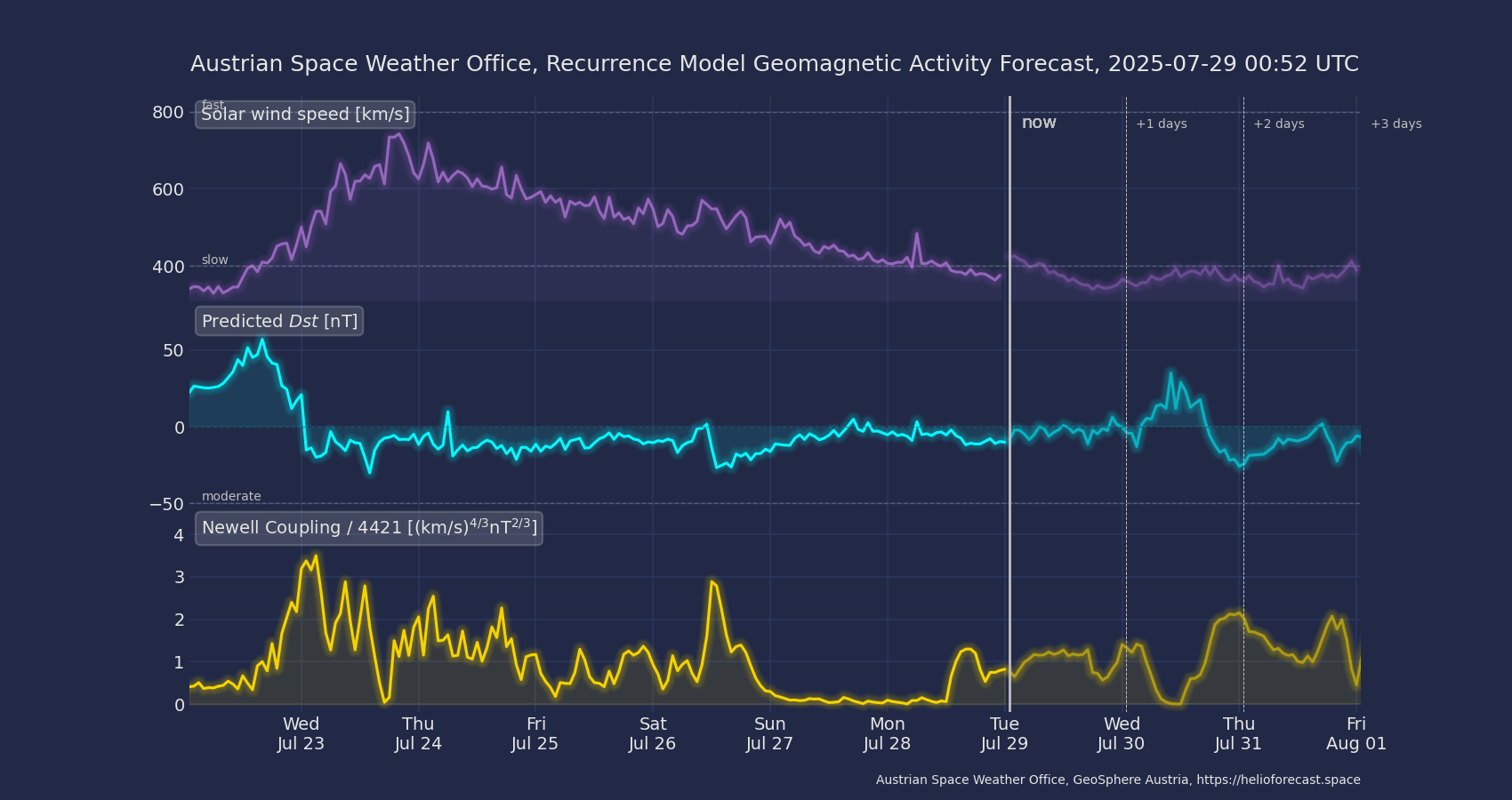
PREDSTORM is our real-time solar wind forecast for the Sun-Earth L1 point. It is updated every 10 minutes, and is based on a recurrence model using the NOAA real time solar wind. The method takes solar wind data from an earlier solar rotation and shifts it forward to provide a persistence forecast. It first checks data from 27 days ago, then falls back to 54 or 81 days ago if the forecast interval has low data coverage or large gaps. This prevents missing archive data from breaking the plots and Dst calculation. We use our own model, based on machine learning, to calculate the geomagnetic Dst index from the solar wind recurrence model forecasts. Caution: This forecast only works for high-speed solar wind streams, and will fail during times when solar storms, also known as coronal mass ejections, impact the Earth's magnetic field.
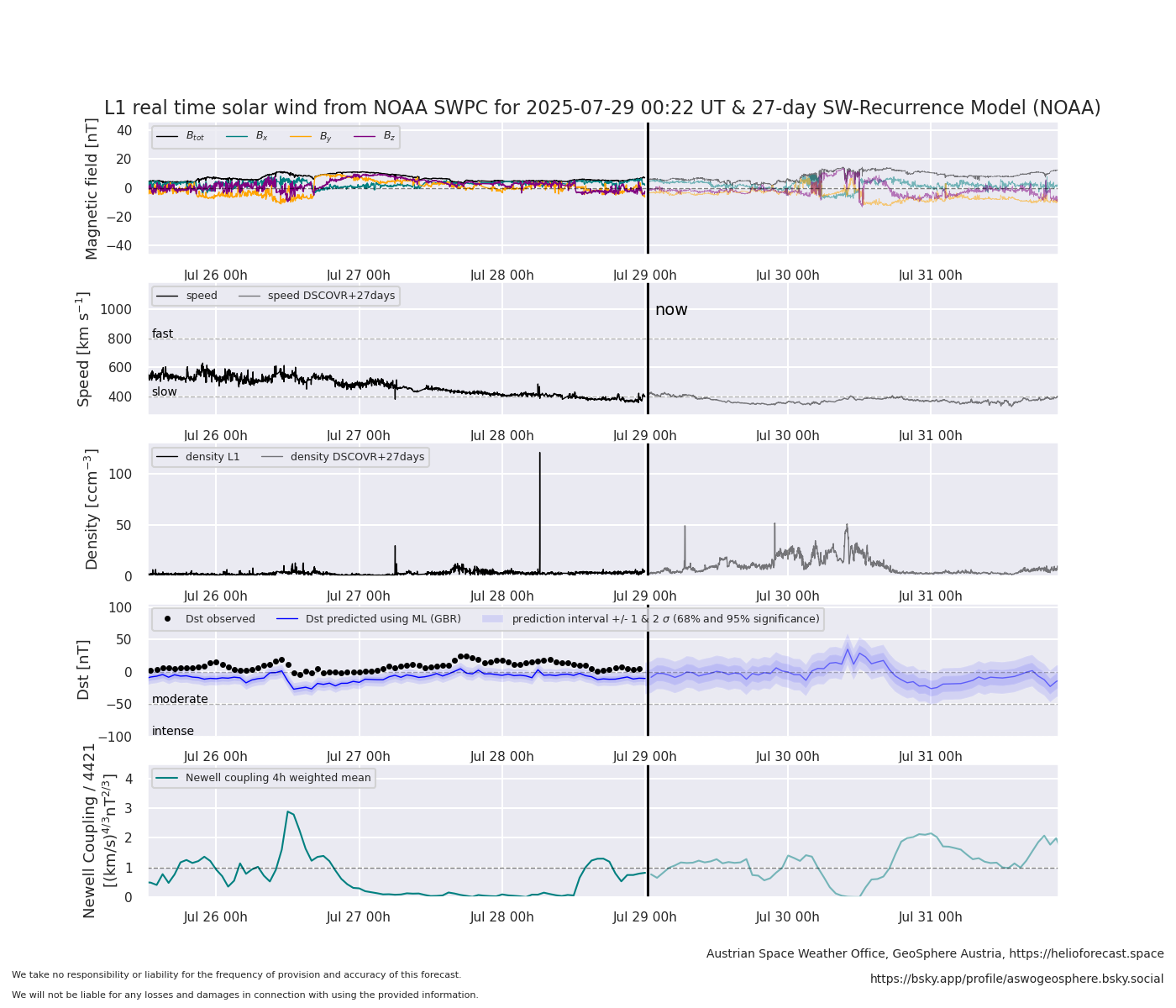
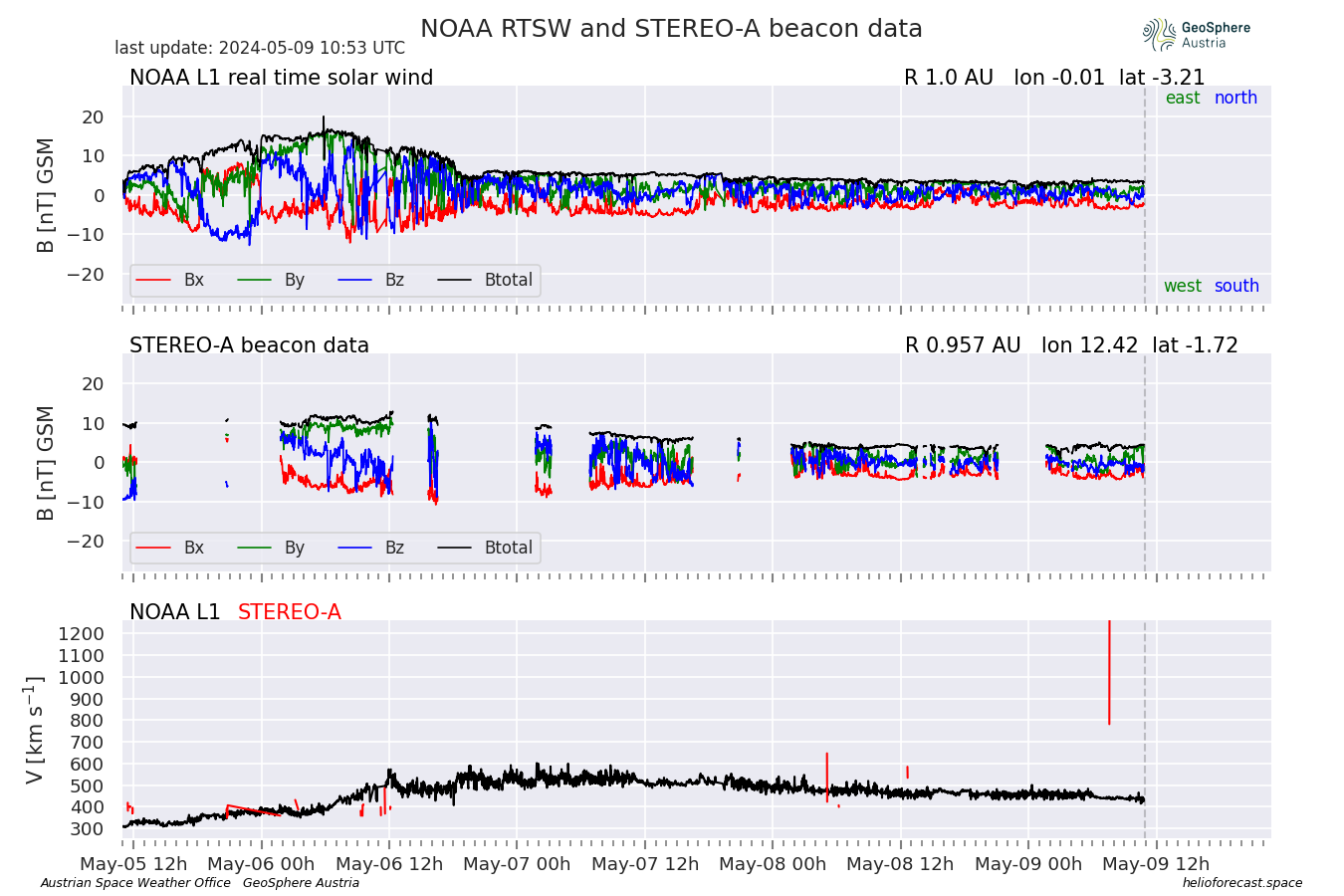
The upper two plots show the same data and forecast, the third plot below shows the NOAA data along with STEREO-A beacon data. STEREO-A was positioned close to Earth in 2023 to 2024, at a distance of 0.05 AU closer to the Sun, and thus formed the first sub-L1 solar wind monitor.
Bailey et al. (2020) presented a study in which STEREO-A in situ data was used for an ambient solar wind forecast. This forms a baseline for techniques to be applied to data returned by the ESA Vigil mission, starting with the early 2030s when Vigil will be stationed at the Sun--Earth L5 point. PREDSTORM will then be able to include real-time data returned by Vigil for forecasting the ambient solar wind at Earth, driven by Vigil data.
The data shown in the plots are available in ASCII format in a 1 hour time resolution and 1 min time resolution.